White House Ignites Fire Under Forest Service and Torches our National Forests
Published on
Jan 16, 2026

By Matt Danielson, Okanogan Forest Sr. Coordinator
The state of the Forest Service in 2025 left communities behind while land management pressed forward with shifting priorities. Across fire-adapted landscapes in Eastern Washington, federal changes reduced the capability of local Districts teams to extinguish wildfire near life and property and to ignite prescribed fires to reduce future wildfire risk. The agency faces great obstacles, but familiar ones: increase forest management productivity and efficiency with less funding, resources, people, and partners than ever before.
In January 2025, the White House directed the Forest Service to increase timber production by 25% across all National Forests. In the following months, the Department of Government Efficiency (DOGE) fired ~3,400 Forest Service employees, about 10% of the agency’s workforce. As I write this in November 2025, the Administration is proposing an additional 34% budget cut to the agency in its fiscal year 2026 budget.
The Administration is aiming to expand domestic timber production by rescinding the 2000 Roadless Area Conversation Rule, offering 40-year contracts with timber companies, and eliminating opportunities for public comment. Despite the intent, the timber industry does not benefit from these actions and is not asking for them. At the start of the government shutdown in October 2025, only activities explicitly related to timber production could be carried out during the shutdown. Road maintenance, surveys, aquatic restoration, prescribed fires, and other restoration actions were delayed, or completely deferred. Across the National Forests, the Forest Service only accomplished 127,000 acres of prescribed burning in 2025 compared to 2 million acres accomplished in 2024 (94% decrease!).
Summer 2025 was a good example of how priorities shift when local fire and forest managers are not in control. The Pomas Fire ignited in early summer and burned 3,600 acres of National Forest. Its spread was slow, and it was situated near wilderness within recent wildfire scars. Many crews and equipment were assigned to actively suppress the wildfire, following new federal direction to suppress all wildfires. Heavy equipment was reassigned away from thinning projects actively reducing future wildfire risk in the Lake Wenatchee area in order to cut a large fire line more than ten miles and a watershed away from the Pomas Fire.

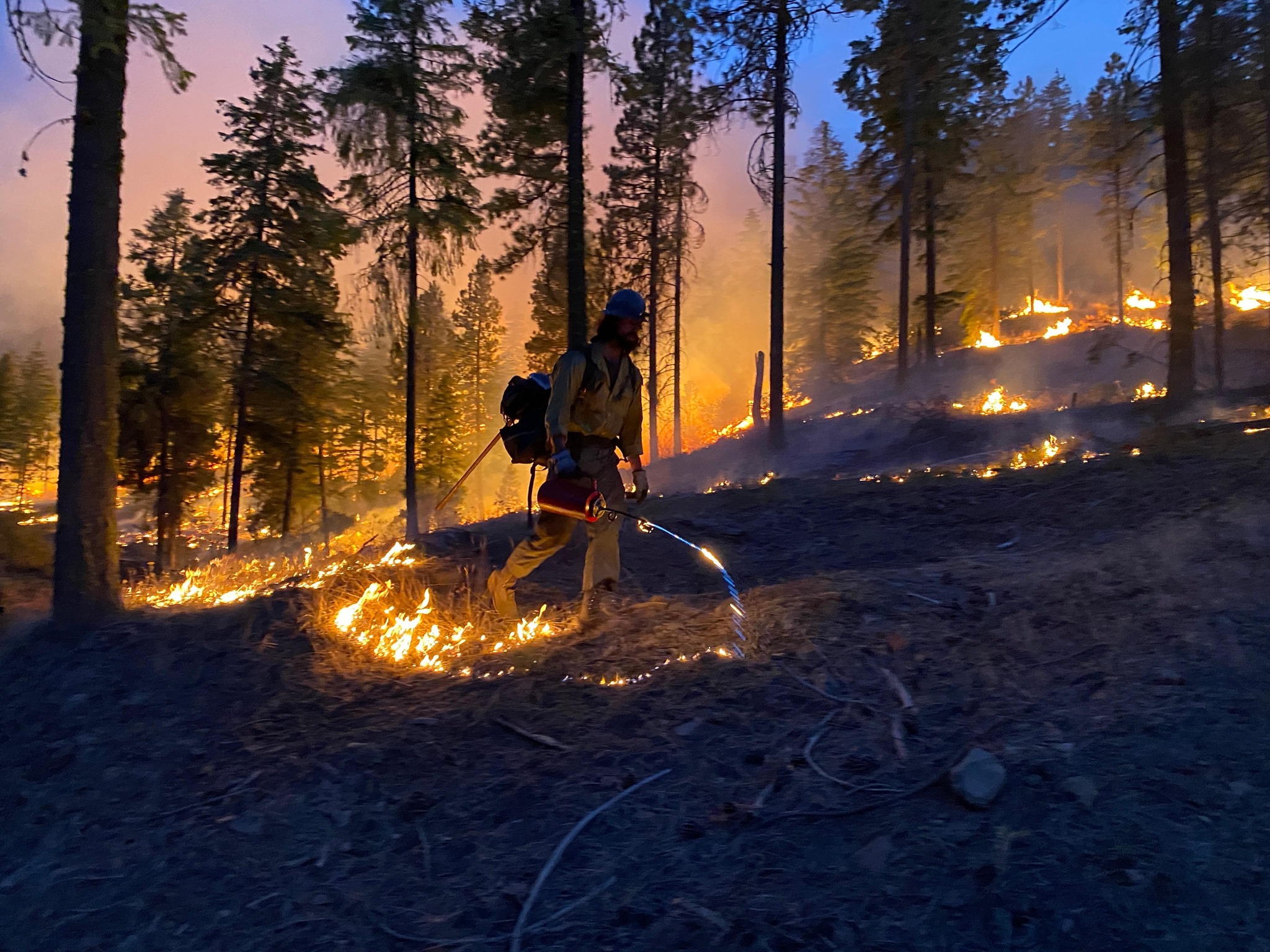
The Forest Service must learn to “do more with less” during this Administration, and prescribed fire remains a valuable tool to do that. Unlike strategies using commercial timber production to tackle wildfire risk, prescribed fire strategies do not require roads, affect native species through familiar ecological processes, and require considerably less permitting, contracting, and NEPA to implement. Increasingly, drone technology is being employed to ignite prescribed fires where inaccessible terrain or fuel conditions pose risks to human safety. Prescribed fire can affect larger areas of wildfire risk than timber production, because fire can move across the landscape on its own, reaching areas otherwise inaccessible for mechanized thinning. By eliminating the need to reload equipment or contract people to walk every acre of the project, we can let fire work for us.